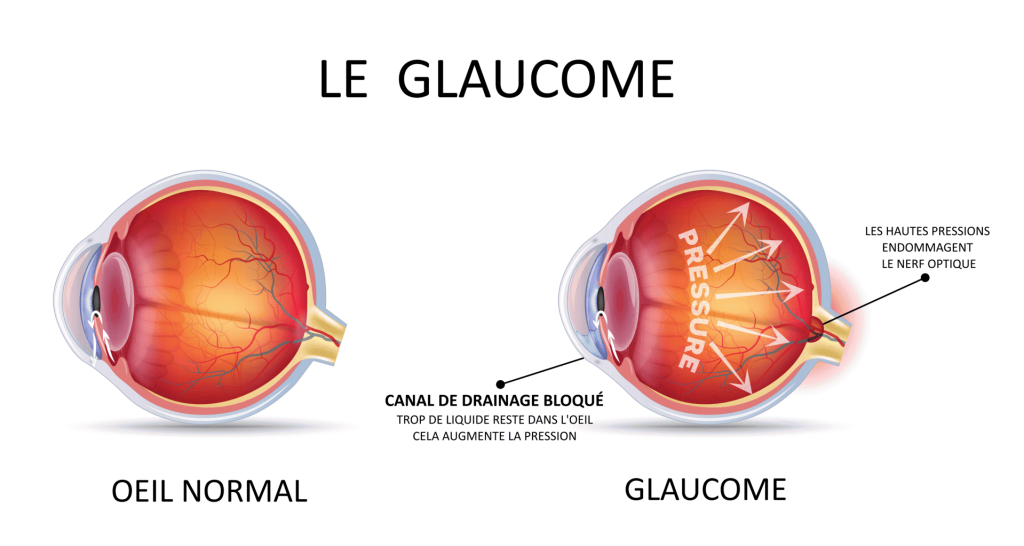
Glaucoma is a chronic eye disease that gradually damages the optic nerve, most often due to excessively high intraocular pressure. It is a silent disease: it causes no pain or symptoms at first, but can lead to irreversible vision loss if not treated in time. The good news: with appropriate treatment and regular monitoring, we can stop its progression.
UnderstandWhy treat glaucoma?
In a healthy eye, a fluid (the aqueous humor) is produced and then evacuated constantly, maintaining a stable pressure. In glaucoma, this fluid is poorly evacuated: the pressure rises and compresses the optic nerve, which transmits images to the brain. Damaged nerve fibers do not regenerate — hence the importance of treating early. The goal of treatment is simple: to lower eye pressure to protect the optic nerve and preserve remaining vision.
1ʳᵉ lineEye drops (drops)
Treatment almost always begins with eye drops to be instilled every day. Several families exist:
- Prostaglandins (latanoprost, travoprost, bimatoprost): these are the most effective, they lower the pressure by 28 to 33%. Only one drop per day, preferably in the evening. It is the most common first-line treatment.
- Beta blockers (timolol): they reduce fluid production, 1 to 2 drops per day. Very well tolerated locally, but avoid in case of asthma or heart problems.
- Alpha-2 agonists (brimonidine) and carbonic anhydrase inhibitors (dorzolamide, brinzolamide): used as second line or in combination.
- Rho-kinase inhibitors (netarsudil): the most recent class, which improves the evacuation of liquid.
When a single eye drop is not enough, several can be combined, often in the form of a combined bottle to simplify treatment.
The right reflexThe importance of observance
Glaucoma can be treated every day, for life. As the disease does not hurt, we are sometimes tempted to forget or stop our drops – this is the main cause of aggravation. Instilling your eye drops at a set time, closing your eyes 1 to 2 minutes after instilling (this doubles the effectiveness) and scrupulously following the prescription are essential to lastingly protect your eyesight.
2ᵉ optionThe SLT laser
The SLT laser (selective trabeculoplasty) is an alternative or complement to eye drops. In a few minutes, painless and in consultation, it improves the natural evacuation of liquid. It is particularly interesting when the drops are poorly tolerated or difficult to take regularly. Its effect lasts several years and the gesture can be repeated.
If necessarySurgery
When eye drops and laser are no longer sufficient to control the pressure, or in cases of advanced glaucoma, surgery may be offered (trabeculectomy, deep sclerectomy, or installation of drainage devices). These interventions create a new evacuation route for the liquid and allow the pressure to be lowered sustainably.
To rememberMonitoring, key to success
Glaucoma treatment is personalized: it depends on the type of glaucoma, the level of pressure, the age and the tolerance of each patient. Regular monitoring (measurement of pressure, visual field, OCT of the optic nerve) makes it possible to check that the disease is well stabilized and to adjust the treatment if necessary. Detected and treated in time, glaucoma does not prevent you from maintaining good vision throughout your life.
Dr Mehdi Batras — Ophthalmologist in Casablanca, holder of a DU in Glaucoma. Regular screening after age 40 is recommended, especially if there is a family history. Make an appointment for an assessment.