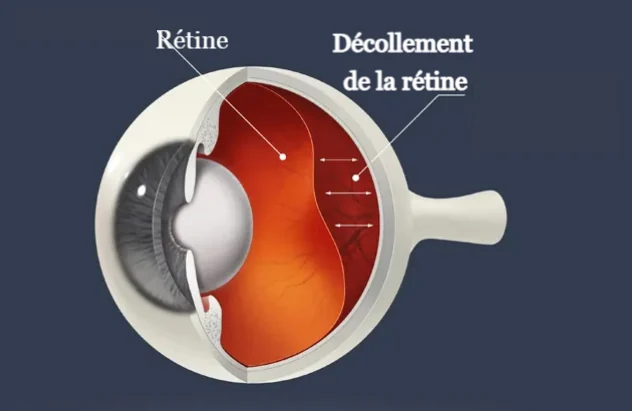

IMPORTANT REMINDER: WHAT IS RETINAL DETACHMENT?
Retinal detachment is a rare ocular pathology, characterized by the separation of the retina from the external membranes of the eyeball, to which it is normally adherent. This break prevents the retina from functioning properly, leading to vision problems. If the detachment is not treated promptly, it can progress to permanent blindness, making urgent medical intervention essential to preserve vision.
HOW TO KNOW IF YOU ARE SICK: THE SYMPTOMS
Symptoms of retinal detachment often appear suddenly and require immediate medical attention. Here are the most common signs:
-
Flashes of light: Sudden appearance of flashes or flashes of light in the visual field, especially on the sides.
-
Spots or floaters: Presence of black spots or floating shapes, often called “flycatchers”, which appear to move in front of the eyes.
-
Shadow or veil: Sensation of a dark veil or shadow that partially or completely covers the field of vision.
These symptoms are important warning signs and require emergency consultation with an ophthalmologist to avoid vision loss.
HOW IT IS CURED: TREATMENT OF RETINAL DETACHMENT
-
Vitrectomy (most common technique): it consists of the removal of the vitreous body which is responsible for the traction on the retina, then healing of the edges of the tear(s) by application of cold or laser, and finally, tamponade of the retina with gas or silicone oil during healing.
-
Cryoindentation (less used currently, but still effective in young or very myopic subjects): it consists of filling the tear(s) by suturing a synthetic material on the external wall of the eye (indentation), then a puncture of the subretinal fluid and finally a cryo-application (healing of the retina by application of cold).
PROGRESS OF THE INTERVENTION
THE FOLLOW-UP OF THE INTERVENTION
I HAVE DETACHMENT
OF THE RETINA,
WHAT SHOULD I DO?
The surgeon chooses the most suitable technique, such as scleral indentation, vitrectomy or cryotherapy.
After the operation, a bandage protects the eye and slight discomfort may be felt, but the pain is usually well controlled. The patient must follow specific postoperative recommendations, including avoiding strenuous physical activities.
Vision recovery takes time and requires regular follow-up with the doctor, to ensure that the retina heals properly and that vision gradually improves.
In the event of symptoms, we advise you to consult our office in EMERGENCY!
Ophthalmologist in Casablanca specializing in the retina
NEED TO CONSULT?
Need medical advice?
Book an appointment with Dr Mehdi Batras for an eye examination tailored to your situation.
Book an appointment